



.webp)


Summary: Choosing the right EMR system in 2026 means matching platform scale to practice size and specialty, not chasing a single "best overall" pick. This guide compares Epic, Oracle Health (formerly Cerner), athenahealth, NextGen, and eClinicalWorks using current KLAS Research rankings and ONC adoption data, and looks at where AI documentation tools genuinely help versus where marketing claims outrun the evidence. For outpatient rehab therapy specifically, SPRY is highlighted as a #1-rated (G2), purpose-built alternative to adapting a general-medicine EMR.
Healthcare professionals face an overwhelming choice when selecting Electronic Medical Record (EMR) systems in 2026. Hundreds of ONC-certified EHR/EMR products are on the market, so the practical question isn't "how many options exist" — it's which system fits a given practice's size, specialty, and workflow.
This EMR comparison guide evaluates the systems clinicians and practice owners search for most — from enterprise hospital platforms to cloud-native ambulatory systems — based on published vendor information, independent research firm data (KLAS Research, ONC/HealthIT.gov), and verifiable 2025–2026 developments.
Why EMR Selection Matters More Than Ever in 2026
According to ONC/HealthIT.gov's most recent data brief, 95% of office-based physicians now report using "any" EHR system, and 91% use a certified EHR — up sharply from the roughly 88%/78% split reported just a few years earlier. Adoption is no longer the challenge; the burden the system creates once it's in place is.
The AMA's 2024 Organizational Biopsy® survey of nearly 18,000 physicians found that even as average workweeks shortened slightly (57.8 hours in 2024 vs. 59 in 2023), physicians still spend about 13 hours a week on indirect patient care — documentation, order entry, test interpretation, and referrals — and 22.5% report more than eight hours a week of after-hours "pajama time" on the EHR, up from 20.9% the year before. Separately, a compiled review of published time-motion studies found physicians spend a median of 3.5 to 6 hours per clinical day interacting with their EHR.
The stakes are higher in 2026 because the bar has moved: practices now need systems that reduce documentation burden with genuinely useful AI, support interoperability standards like FHIR and TEFCA, and hold up under tightening data-security expectations. An EMR comparison matrix like this one is meant to help providers evaluate platforms on the factors that actually move the needle: mobile access, realistic implementation timelines, and lab/imaging integration.
Key Challenges Healthcare Professionals Face
Independent research points to several recurring pain points in EMR use:
- Documentation Overload: published time-motion studies put median daily EHR time at roughly 3.5–6 hours per clinical day
- Workflow Disruption: poor system integration and change-management gaps routinely add administrative burden during and after go-live
- Usability Issues: a 2025 national physician survey published in npj Digital Medicine found EMR usability rated at just 52% of the maximum possible score, with roughly half of respondents calling their system inefficient or reporting overall dissatisfaction
- Interoperability Gaps: data sharing between systems has improved through FHIR APIs and TEFCA, but gaps between vendors and care settings remain common
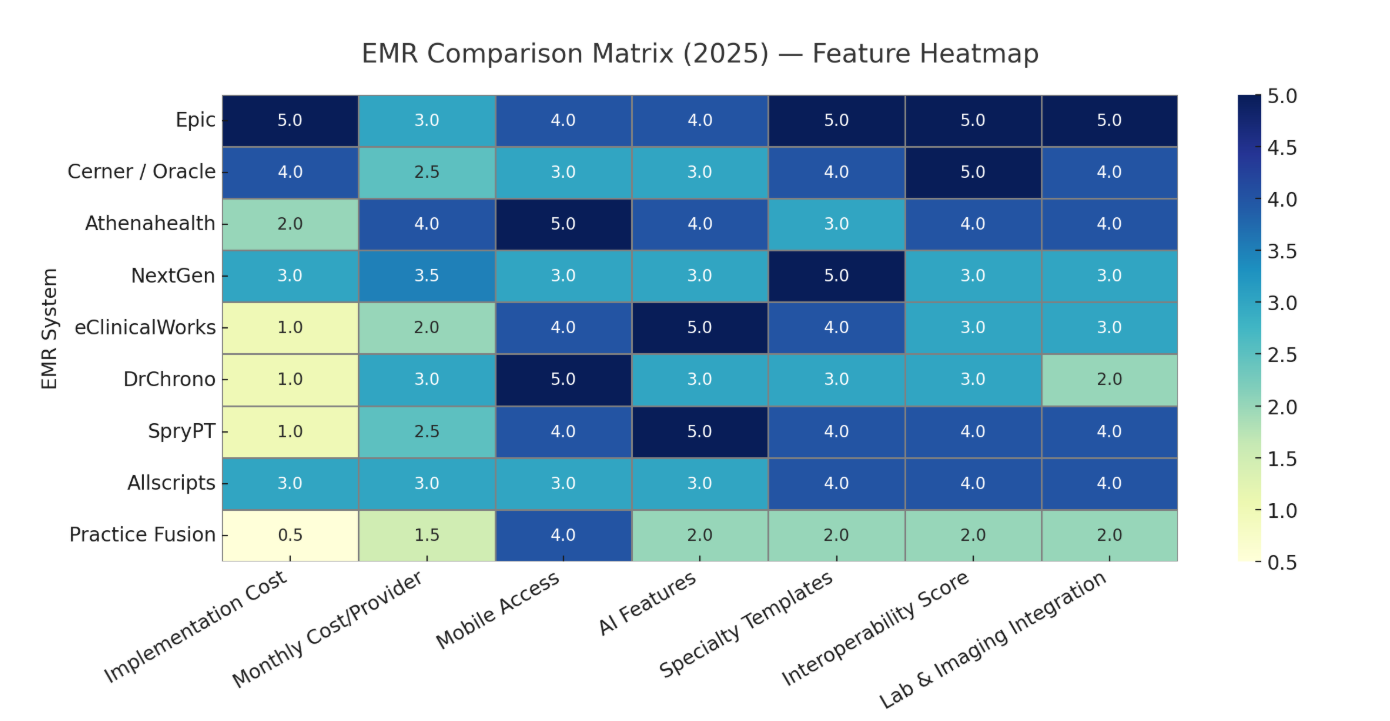
What Is EMR Lab and Imaging Integration in 2026?
Lab and imaging integration in EMR systems allows automated data flow from diagnostic systems like:
- Laboratory Information Systems (LIS)
- Picture Archiving and Communication Systems (PACS)
- Radiology Information Systems (RIS)
In 2026, this integration matters more than ever because:
- ONC and CMS continue pushing FHIR-based data exchange and the Trusted Exchange Framework and Common Agreement (TEFCA) toward broader real-time interoperability
- AI-assisted imaging diagnostics are being deployed at a growing number of health systems
- Value-based care models reward faster test-to-treatment workflows, making lab/imaging turnaround time a direct financial metric, not just a clinical one
Top EMR 2026 Systems: Performance-Based Rankings
Epic Systems: The Enterprise Leader
Best For: Large health systems, hospitals, academic medical centers
Epic remains the dominant enterprise EHR by market share. KLAS Research's 2026 market-share tracking found Epic added 77 hospitals and roughly 18,700 beds over the prior year, while Oracle Health lost 56 hospitals and about 14,700 beds — continuing a multi-year trend. Epic was also named the Best in KLAS overall software suite winner for the 15th consecutive year in the 2025 rankings.
Key Strengths:
- Broad acute-care and ambulatory market share, with strong data exchange through its Care Everywhere network
- Robust population health management tools and advanced analytics/reporting
- Strong patient portal functionality (MyChart)
- In an independent 2025 KLAS study of 87 independent ambulatory organizations, Epic's ambulatory offering scored 82.3/100 overall (a "B" grade), with a 91.0 core-EHR score and 92.0 practice-management score among larger independent groups
Limitations:
- Epic does not publish list pricing; independent implementation analyses consistently describe large health-system rollouts as multi-year, multi-million-dollar undertakings, with cost scaling heavily by organization size and scope
- Extensive training requirements
- Complex interface that can slow clinical workflows for smaller, ambulatory-only practices — the platform is generally built for enterprise scale, not solo or small-group practices
Oracle Health (formerly Cerner): A Platform in Transition
Best For: Government facilities, academic institutions, large hospital networks
Oracle's 2022 acquisition of Cerner is well established, but 2025–2026 marks a bigger shift: Oracle has said its next-generation EHR, built on Oracle's cloud and AI stack, is a genuinely new platform rather than "a refurbished Cerner EHR," with a phased rollout beginning in 2025. Existing Cerner/Oracle Health customers are being migrated over time rather than all at once.
Key Strengths:
- Strong security posture for government and federal-adjacent compliance requirements
- Integration with Oracle's broader cloud and analytics stack
- Comprehensive revenue cycle management tooling
Limitations:
- KLAS's 2026 market-share data shows Oracle Health losing hospital accounts for a third consecutive year, both domestically and, more recently, in some international markets
- Customers face a multi-year migration path to the new platform, adding planning complexity
- Historically inconsistent interface across modules, though this is part of what the new platform aims to address
Athenahealth: Cloud-Native Ambulatory Leader
Best For: Ambulatory practices, specialty clinics, independent physician groups
Athenahealth pioneered cloud-based EMR delivery for ambulatory care and continues to be a top performer in independent-practice rankings. In the 2025 Best in KLAS awards, athenahealth's athenaClinicals won the Ambulatory EHR category for independent practices with 11–75 physicians, and the company was also named a 2025 Overall Best in KLAS award recipient.
Key Strengths:
- Cloud-native architecture with strong uptime track record
- Integrated revenue cycle management
- Consistently strong performance in independent-practice KLAS rankings
- Mobile and patient-portal capabilities built for ambulatory workflows
Limitations:
- Pricing is not published; quotes are practice-specific
- Limited fit for inpatient/hospital-scale needs
- Frequent platform updates can disrupt established workflows
NextGen Healthcare: Specialty Practice Focus
Best For: Specialty practices, behavioral health, cardiology, orthopedics
NextGen Healthcare was taken private by Thoma Bravo in 2023 and continues to operate under the NextGen brand, with continued investment in specialty-specific templates and workflows.
Key Strengths:
- Extensive specialty-specific templates
- Clinical decision support tooling
- Patient engagement tools
- Flexible customization options
Limitations:
- Pricing not published; typically positioned above budget-tier ambulatory EMRs
- Some users report inconsistent performance across modules
- Reporting features can be complex to configure
eClinicalWorks: AI-Powered Documentation
Best For: Primary care practices, multi-specialty groups, telehealth-focused practices
eClinicalWorks continues to invest in AI-assisted documentation (its healow ecosystem) and patient engagement tools, positioning it for practices prioritizing automation on a mid-market budget.
Key Strengths:
- AI-assisted documentation capabilities
- Comprehensive telehealth integration
- Patient portal via the healow app
- Generally positioned as more budget-friendly than enterprise-tier competitors
Limitations:
- Mixed reviews on customer support responsiveness
- Interface design lags newer cloud-native competitors
- Occasional downtime reported during platform updates
| EMR System | Best Fit | Pricing Model | Mobile App | AI Documentation | 2025–2026 Recognition |
|---|---|---|---|---|---|
| Epic | Large health systems, hospitals | Not published; enterprise custom quote | MyChart (patient), Haiku/Canto (clinician) | Growing AI/analytics suite | Best in KLAS overall (15th year, 2025); gaining hospital market share (KLAS 2026) |
| Oracle Health (Cerner) | Government, academic, large networks | Not published; enterprise custom quote | Mobile access via Oracle Health apps | New AI-native platform rolling out 2025+ | Losing hospital share 3rd year running (KLAS 2026) |
| Athenahealth | Ambulatory, independent practices | Not published; per-practice quote | Responsive web + mobile patient access | Automated clinical documentation features | Best in KLAS: independent ambulatory 11–75 MDs (2025) |
| NextGen Healthcare | Specialty practices | Not published; per-practice quote | NextGen mobile apps | Clinical decision support tooling | Privately held (Thoma Bravo, 2023–present) |
| eClinicalWorks | Primary care, multi-specialty | Not published; generally mid-market | healow patient app | AI-assisted documentation via healow | Established mid-market ambulatory vendor |
| DrChrono (EverHealth) | Small practices, mobile-first teams | Not published; per-provider quote | Native iPad app | Basic automation features | Owned by EverCommerce/EverHealth |
| Veradigm (formerly Allscripts) | Mid-size to large practices | Not published; enterprise quote | Mobile access via Veradigm apps | Analytics-focused, less ambient-AI-forward | Renamed from Allscripts in 2023; owns Practice Fusion |
| Practice Fusion (Veradigm) | Very small/budget-conscious practices | Not published; low-cost tier | Limited native mobile support | Minimal AI features | Now part of Veradigm |
| SPRY (PT/OT/SLP focus) | Outpatient rehab therapy clinics | Visit-based subscription (Essentials/Plus), published tiers, plus optional billing add-on at 4–6% of collections | Companion app for therapists + iPad/tablet intake kiosk | Built-in AI Scribe (ambient documentation) | 4.8/5 on G2 and Capterra; 1,000+ rehab clinics |
Note on pricing: with the exception of SPRY, none of the vendors above publish list pricing, and quotes vary significantly by practice size, modules selected, and negotiated terms — treat any specific dollar figure you see elsewhere as an estimate, not a quote.
EMR Mobile Access for Physicians in 2026
Mobile accessibility remains a top priority as care delivery continues to shift toward hybrid and telehealth-inclusive models.
Leading Mobile EMR Approaches
DrChrono: iPad-first design
- Native iPad application with broad feature coverage
- Patient data synchronization
- Mobile-optimized charting interface
- Telehealth capabilities
Athenahealth: Cloud-native mobile optimization
- Responsive design across devices
- Mobile patient portal integration
- Real-time appointment scheduling
- Secure messaging capabilities
Epic MyChart: Patient engagement leader
- Comprehensive patient portal access
- Provider mobile apps (Haiku/Canto)
- Care-team communication tools
- Mobile-optimized clinical workflows
SPRY: Rehab-specific mobile workflow
- Companion mobile app for therapists, per SPRY's published feature list
- iPad/tablet kiosk app for patient intake
- Online scheduling and patient portal included in the Essentials plan
- Rated 4.8/5 on both G2 and Capterra
| EMR System | Native Clinician App | Patient Portal App | Notable Recognition |
|---|---|---|---|
| DrChrono | Yes (native iPad app) | Yes | Long-standing mobile-first EHR, now under EverHealth |
| SPRY | Yes (therapist companion app) | Yes (patient portal, Essentials plan) | 4.8/5 on G2 and Capterra |
| Athenahealth | Responsive web, no dedicated native clinician app | Yes | Best in KLAS, independent ambulatory (2025) |
| Epic | Yes (Haiku/Canto) | Yes (MyChart) | Best in KLAS overall, 15th consecutive year (2025) |
| eClinicalWorks | Limited native clinician app | Yes (healow) | Established mid-market ambulatory vendor |
AI Documentation and EMR Summarization Solutions Compared
AI-powered documentation tools represent one of the fastest-moving parts of the EMR market. It's also where marketing claims tend to run furthest ahead of independent evidence, so it's worth separating vendor-reported numbers from third-party research.
Leading AI Documentation Solutions
Microsoft Dragon Copilot: Unified ambient AI assistant
- Launched by Microsoft in March 2025, unifying the former Dragon Medical One and DAX Copilot products into a single assistant
- Converts multi-party, multilingual conversations into specialty-specific notes
- Integrates with major EMR systems and supports medical terminology and specialty vocabularies
- Pricing is not publicly listed; Microsoft requires a sales conversation for terms
SPRY AI Scribe: Rehab-specific documentation automation
- Real-time ambient listening and transcription built for PT, OT, and speech-language pathology visits
- Vendor-reported SOAP note generation in under two minutes, with a stated accuracy rate above 99%
- Automated coding suggestions and structured note formatting
- Free tier available at scribe.sprypt.com; premium tiers via SPRY's pricing page
Abridge: AI-powered clinical conversations
- Real-time conversation analysis and automated clinical note generation
- Integration with major EMR platforms
- HIPAA-compliant processing is a baseline requirement for any AI documentation vendor handling PHI, not a differentiator by itself
What the Independent Research Actually Shows
Vendor-reported time savings for ambient AI documentation tools vary widely, and the best independent evidence available suggests real-world results are more modest than most marketing claims imply. A large 2026 study published in JAMA, covering more than 1,800 clinicians using AI scribes against roughly 6,770 control clinicians, found average reductions of 13 minutes per day in EHR use (a 3% relative decrease) and 16 minutes per day in documentation time (a 10% relative decrease). Clinicians who used the tool for more than half of their visits saw roughly double the EHR-time reduction and triple the documentation-time reduction — but only about 32% of users reached that adoption level.
That doesn't make ambient AI documentation a bad investment — a consistent 10% reduction in charting time, sustained across a career, adds up — but it argues for evaluating any vendor's efficiency claims against how it was measured (self-reported survey vs. logged EHR time-motion data) and how consistently clinicians actually use the tool day to day.
Specialty-Specific EMR Solutions
Different medical specialties require tailored functionality. The right feature comparison varies significantly based on specialty requirements.
Physical, Occupational, and Speech Therapy EMR Solutions
SPRY: AI-native EMR and RCM platform built for outpatient rehab
- Used by more than 1,000 rehab clinics, per SPRY's own published figures, with a #1-rated G2 position among rehab-focused EHRs
- Automated billing, with SPRY reporting 40% fewer denials, 30% faster reimbursements, and a 95% clean claim rate on its own billing product page
- Treatment plan and documentation workflows built specifically for PT, OT, and speech-language pathology, not adapted from a general medical template
- For a deeper look at how SPRY compares with other therapy-specific EHRs, see our full guide to the best EHR for private practice therapy
WebPT: Long-standing PT-specific software
- Outcome measurement integration
- Exercise prescription tools
- Insurance authorization tracking
- Patient engagement portal
Mental Health EMR Leaders
TherapyNotes: Behavioral health specialist
- Comprehensive treatment planning tools
- Insurance verification automation
- Telehealth integration with session notes
- Outcome measurement tracking
TheraNest (Therapy Brands/Ensora Health): Multi-disciplinary mental health
- Group therapy management
- Family therapy documentation
- Progress note templates
- Billing optimization features
Implementation Success Factors
Successful EMR implementation requires strategic planning and change management. KLAS Research's 2025 Arch Collaborative implementation report — based on feedback from healthcare organizations that recently went live — found that only 38% described their implementation as having "hit the mark," while 40% reported "significant misses" and 22% reported average results with room for improvement. The same report found that 75% of clinicians who were dissatisfied right after go-live were still dissatisfied with their EHR two or more years later, and that inadequate change management and training — not the software itself — was the most frequently cited root cause.
Critical Success Factors
Leadership Commitment: Executive sponsorship and physician champions
Workflow Analysis: Detailed current-state and future-state mapping
Training Programs: Comprehensive user education and support, sustained well past go-live
Data Migration: Accurate historical data transfer — see our EMR data migration guide for a practice-level walkthrough
Go-Live Support: Dedicated technical support during transition
Implementation Timeline Benchmarks
- Small Practices (1–5 providers): commonly 1–6 months, depending on data migration complexity
- Medium Practices (6–25 providers): commonly 3–12 months
- Large Organizations (25+ providers): commonly 12–24 months
- Health Systems (multiple locations): commonly 18–36+ months
These ranges vary considerably by vendor and scope. For a specialty example, SPRY publishes a structured 60-day rollout plan for PT clinics — see the PT EMR implementation timeline for the phase-by-phase breakdown.
Cost Analysis and ROI Considerations
EMR investment requires careful financial analysis. Total cost of ownership includes licensing or subscription fees, implementation and training, ongoing support, and system upgrades — and for enterprise vendors like Epic, Oracle Health, and NextGen, none of that is published, so a real quote requires an RFP process.
Cost Categories
Upfront/Implementation Costs:
- Software licensing or setup fees
- Hardware requirements
- Data migration expenses
- Training and support costs
Ongoing Costs:
- Monthly or per-visit subscription fees
- Technical support contracts
- System upgrade expenses
- Additional user licenses
Budget-conscious independent practices weighing per-provider or per-visit subscription models against larger enterprise platforms can find a broader cost comparison in our guide to affordable healthcare practice management platforms.
ROI Considerations
Rather than citing a single blended ROI percentage — which varies enormously by starting point, specialty, and how well the implementation was run — practices typically evaluate EMR ROI across four categories: administrative labor reallocated from paper-based or duplicate-entry workflows, claim/billing accuracy improvements that reduce denials and rework, patient-throughput changes from more efficient scheduling and intake, and reduced reliance on outside transcription services. The KLAS Arch Collaborative data above is a useful reminder that these gains are not automatic: they track closely with how well the implementation itself was executed.
EMR Technology Trends Heading Into 2026 and Beyond
Key Technology Trends
Artificial intelligence integration:
- Ambient documentation and AI scribes, now with real (if modest) independent evidence behind the time savings
- Clinical decision support and predictive analytics, expanding but still requiring human oversight
- Automated coding and billing suggestions
Interoperability advancement:
- FHIR-based data exchange
- TEFCA-enabled, near-real-time health information networks
- Cross-platform data sharing
- Patient-directed access to their own records
Patient engagement evolution:
- Wearable device integration
- Behavioral health and social-determinants tracking
- Personalized care plan delivery
For a deeper look at where these trends are headed, see our full breakdown of electronic health record future trends.
Conclusion: Making the Right EMR Choice
Selecting the optimal EMR system requires balancing functionality, cost, and workflow integration against your practice's actual size and specialty — not a generic "best overall" ranking. Enterprise systems like Epic and Oracle Health dominate hospital and health-system deployments; ambulatory-focused platforms like athenahealth, NextGen, and eClinicalWorks serve independent and specialty practices; and specialty-specific systems like SPRY exist because general-purpose EMRs often require expensive customization to handle discipline-specific documentation and billing.
The comparison above shows real, current variation in vendor recognition, market trajectory, and feature focus — but very little of it in verifiable pricing, since most major vendors simply don't publish it. Before committing, request demonstrations, talk to current customers in a similar specialty and practice size, and, where possible, pilot the system with real patient volume before signing a multi-year contract.
Sources and References:
- ONC/HealthIT.gov, Office-based Physician Electronic Health Record Adoption, 2008–2024
- American Medical Association, 2024 Organizational Biopsy® physician workload survey
- KLAS Research, 2025 Best in KLAS Awards and 2025 Arch Collaborative EHR Implementations report
- KLAS Research, 2026 EHR Market Share Report (via HIT Consultant)
- npj Digital Medicine, EMR usability and patient safety national survey, 2025
- JAMA, ambient AI scribe real-world time-motion study, 2026 (via STAT News/EurekAlert)
Reduce costs and improve your reimbursement rate with a modern, all-in-one clinic management software.
Get a DemoLegal Disclosure:- Comparative information presented reflects our records as of Nov 2025. Product features, pricing, and availability for both our products and competitors' offerings may change over time. Statements about competitors are based on publicly available information, market research, and customer feedback; supporting documentation and sources are available upon request. Performance metrics and customer outcomes represent reported experiences that may vary based on facility configuration, existing workflows, staff adoption, and payer mix. We recommend conducting your own due diligence and verifying current features, pricing, and capabilities directly with each vendor when making software evaluation decisions. This content is for informational purposes only and does not constitute legal, financial, or business advice.

