

Summary: A guide to RCM for small PT, OT and SLP practices with 1 to 5 providers. It compares in-house billing, outsourced billing and EMR-integrated RCM, walks through illustrative cost ranges for a 3-provider practice, and lists what to confirm with each vendor. SPRY, trusted by 1000+ clinics, starts at $79/provider/month, and its optional managed RCM service is 4% to 6% of collections.
SPRY is an AI-first EMR and RCM platform built for small PT, OT, and SLP practices. It is built specifically for outpatient rehab, not a generic medical billing tool and not a documentation system with billing bolted on. A 1–5 provider practice gets specialty-aware coding (time-based CPT units, the 8-minute rule, Medicare thresholds), and SPRY reports 95%+ clean claims on first submission, 24–48 hour denial resolution, and 97%+ eligibility accuracy before check-in, all without hiring a dedicated biller or handing billing to a generalist vendor.
Trusted by 1000+ clinics, SPRY starts at $79/provider/month, and its optional managed RCM service is 4% to 6% of collections, based on total number of billable appointments. SPRY holds 4.8/5 on Capterra (74 reviews) and 4.6/5 on G2 (98 reviews).
Why Does Practice Size Change the RCM Decision?
Most RCM content is written for hospital systems or 20+ location groups, where a dedicated billing department, a compliance officer, and a six-figure RCM budget are already assumed. None of that applies at your size. A solo PT or a 3-provider OT clinic is usually choosing between:
- The owner or office manager doing billing themselves, in addition to everything else they already do
- Hiring one part-time or full-time biller
- Outsourcing to a billing company or RCM vendor that works alongside (or instead of) your current EMR
At this scale, every hour spent chasing a denial is an hour not spent on patient care or growth, and every percentage point taken by a vendor is felt directly on a smaller revenue base.
The Three Models, Sized for Small Practices
1. In-House Billing
- Cost: Salary and overhead for whoever does the billing, plus your EMR’s billing module fees.
- Staffing: Requires someone who understands PT/OT/SLP-specific coding: time-based CPT units, the 8-minute rule, modifiers, and Medicare thresholds.
- Complexity: Highest personal burden. You own every denial, every appeal, and every payer follow-up call.
- Where it breaks down: Turnover. If your one trained biller leaves, billing knowledge often leaves with them.
2. Outsourced Third-Party Billing
- Cost: Often quoted as a percentage of collections, roughly 4% to 8%, so get an itemized quote.
- Staffing: None internally, but you can lose direct visibility, and some vendors are generalists rather than therapy specialists.
- Complexity: Lower day-to-day burden, but you’re managing a vendor relationship and reconciling reports manually.
- Where it breaks down: Opacity. When a claim stalls, you’re often waiting on an email back from a biller juggling dozens of other clients.
3. EMR-Integrated RCM
- Cost: SPRY's managed RCM service is 4% to 6% of collections, based on total number of billable appointments.
- Staffing: Minimal internal staffing needed; your front desk sees real-time status instead of waiting on a separate vendor.
- Complexity: Lowest ongoing burden: eligibility, documentation, coding, and billing aren’t fragmented across tools.
- Where it breaks down: Only if the “integration” is superficial, for example when billing is bolted on without real data connectivity.
Test for visibility, not just labor replacement
Decision Framework: Which Model Fits Your Practice?
Use this as a quick gut-check, not a rigid rule:
| If your practice looks like this... | Consider... |
|---|---|
| Solo provider, low visit volume, simple payer mix, you enjoy the admin work | In-house may work short-term, but budget for the time cost |
| 1–5 providers, growing visit volume, no one internally wants to own billing | Outsourced or integrated RCM |
| Frequent denials, unclear A/R status, staff spending hours reconciling claims | Integrated RCM, because the visibility gap is usually the real problem |
| Considering outsourcing but don't want to give up your current EMR | Look for RCM services built to plug into your existing system |
| Ready to consolidate documentation and billing into one workflow long-term | Fully integrated EMR + RCM platform, such as SPRY |
The pattern worth noticing: the more your practice's pain point is visibility (not knowing what's paid, pending, or denied without chasing someone down) rather than pure labor (just needing hands to do data entry), the less a generic outsourced biller solves your actual problem, because opacity is often what you're outsourcing into, not out of.
The Real Cost Math for a Small Practice
A simplified comparison for a 3-provider practice collecting roughly $600K/year ($200K per provider).
| Model | Approximate Annual Cost | What You Get |
|---|---|---|
| In-house (1 biller) | $35,000–$55,000/year | Full control, but you own turnover risk and specialty-coding learning curve |
| Outsourced third-party (4–8%) | $24,000–$48,000/year | Reduced internal labor, but some vendors are generalists and reports can lag |
| SPRY EMR-integrated RCM (4–6%) | $24,000–$36,000/year | Specialty-aware billing, real-time dashboards, no separate vendor to manage |
These are illustrative ranges to show the model differences, not a quote. Actual numbers depend on visit volume, payer mix, and denial rates, and the SPRY EMR subscription ($79/provider/month) is separate from the RCM percentage. In general, a billing model that starts from clean clinical data has less rework, which is worth weighing when you compare percentage rates.
How Does SPRY Compare to Other EMR + Billing Platforms?
Platforms differ in how billing connects to documentation: some run billing as a separate module or add-on, and others share one data set. SPRY states that billing, documentation, eligibility, and coding run on one data set from a single codebase. The table below lists what to confirm with each vendor.
| Platform | Architecture | Billing Model | Pricing | What to Confirm |
|---|---|---|---|---|
| SPRY | AI-first EMR + RCM for outpatient PT/OT/SLP; SPRY states billing, documentation, eligibility, and coding share one data set | Native EMR-integrated RCM, or a billing service that plugs into your existing EMR | EMR starts at $79/provider/month; managed RCM 4% to 6% of collections | 4.8/5 on Capterra (74 reviews) and 4.6/5 on G2 (98 reviews); SPRY reports 95%+ clean claims, 24–48hr denial resolution, under 7 days in A/R, 97%+ eligibility accuracy |
| WebPT | Rehab therapy EMR for PT, OT, and SLP clinics | Confirm with vendor | Confirm with vendor | Whether billing runs inside the EMR or as a separate module, and what is bundled |
| Prompt | Rehab therapy EMR and practice management platform | Confirm with vendor | Confirm with vendor | Which AI and analytics features are in the base plan and which are add-ons |
| athenahealth | General medical EHR and RCM platform | Confirm with vendor | Confirm with vendor | Fit for PT/OT/SLP coding rules such as time-based units and Medicare thresholds |
| Tebra | Practice management and EHR platform for independent practices | Confirm with vendor | Confirm with vendor | Fit for PT/OT/SLP coding rules, and which modules cost extra |
| Systems4PT | PT-focused documentation and billing software | Confirm with vendor | Confirm with vendor | Whether billing is operated by your staff or a vendor team, and how it connects to documentation |
| HelloNote | Therapy documentation software | Confirm with vendor | Confirm with vendor | Which plan tier includes billing tools, and who works claims on your behalf |
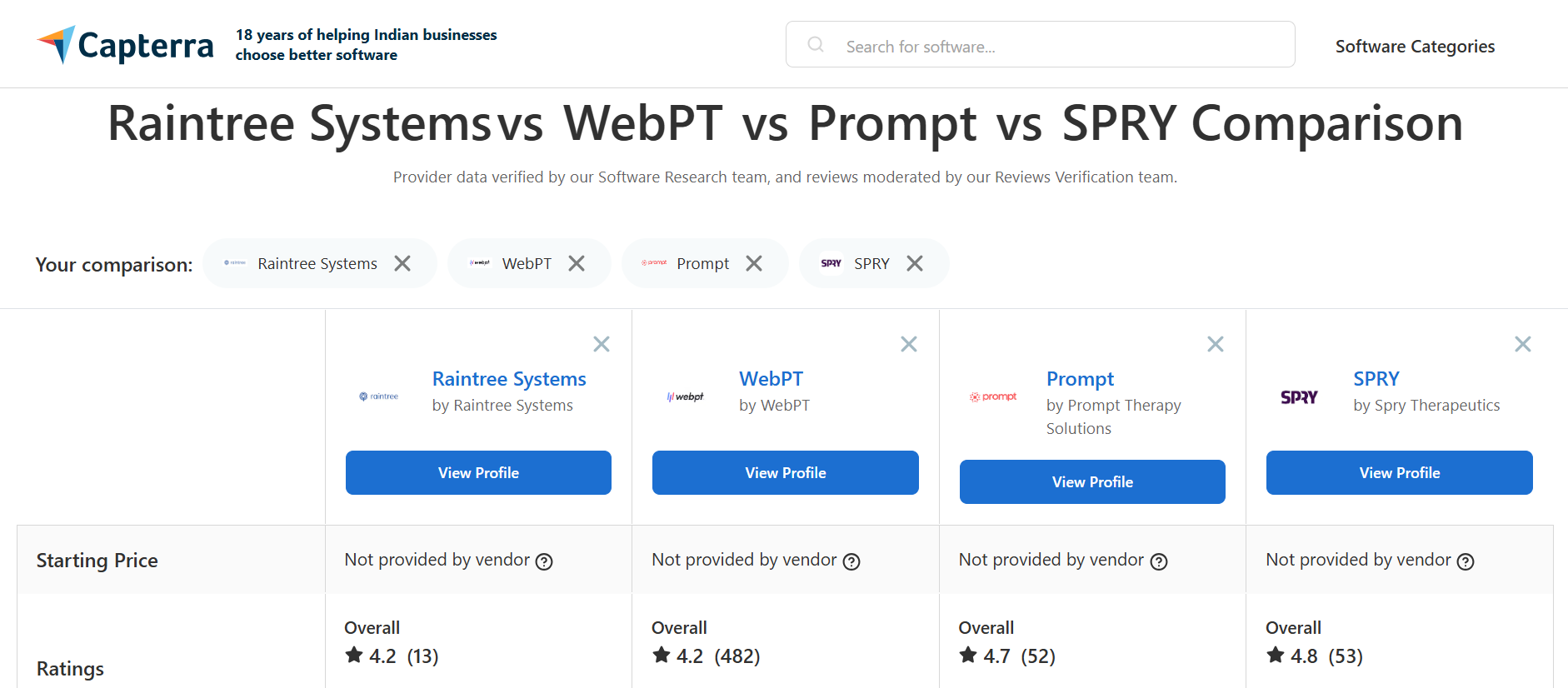
The Capterra comparison above was captured in June 2026, and ratings and review counts change, so check current G2 and Capterra listings. Whichever platform you consider, ask whether billing runs on the same data as clinical documentation or through a separate module or data feed, and who owns a claim when it stalls.
If you're not ready to move your documentation off your current EMR, SPRY's revenue cycle management service is built to plug into the system you already use. Your team keeps its existing workflow, and a dedicated RCM team handles claims, denials, and payment posting in the background, with real-time dashboards so you're never waiting on a status email. If you're open to consolidating documentation and billing into a single system long-term, SPRY's fully integrated EMR + RCM path removes the handoff between clinical notes and claims, so the note that documents the visit is the same data that drives the claim.
Real Practices, Real Results
“Switching to SPRY cut denials by 95% and boosted revenue by more than 20% on a $5.2M base.”
Marc Douek, Managing Partner & Co-Owner, Renew Physiotherapy
“Revenue grew nearly 20% with billing running without constant oversight.”
Sam Shah, DPT, Owner, Movement Physical Therapy
“SPRY’s real-time analytics gave our team complete visibility into claims and therapist performance so we could catch trends early.”
Bryan Davis, DPT, Co-Owner, Excel Therapy
FAQs
Is it cheaper to bill in-house or outsource RCM for a small PT practice?
It depends on your visit volume and how much your time is worth. In-house billing avoids a percentage-of-collections fee but requires either your own time or a salaried biller, plus the risk of turnover and a specialty-coding learning curve.
Outsourcing removes the labor burden but is often quoted at roughly 4% to 8% of collections. SPRY's optional RCM and billing service is 4% to 6% of collections, based on total number of billable appointments, per its pricing page, and works from the data in your EMR rather than re-entering it.
What’s the difference between hiring a biller and using an RCM service?
A biller is an employee or contractor you manage directly, on your payroll or as a fixed fee, doing the billing work themselves inside your existing tools. An RCM service is a team and system working on your behalf, usually paid as a percentage of collections, that owns eligibility checks, claim scrubbing, submission, and denial follow-up as their core job.
Can I use an RCM service without switching my EMR?
Yes. SPRY’s revenue cycle management service is built to integrate with the EMR you’re already using, so your clinical team doesn’t need to retrain or migrate data. A dedicated RCM team handles claims, denials, and payment posting in the background, with real-time dashboards so you’re never waiting on a status email.
What should a small PT/OT/SLP practice look for in an RCM vendor?
Specialty experience with time-based CPT coding and the 8-minute rule, real-time reporting, a transparent percentage-of-collections rate with no hidden add-ons, and clear denial-resolution timelines. If a vendor can’t tell you their average days-in-A/R or clean-claim rate, ask directly before signing.
How much revenue do small practices typically lose to billing inefficiency?
This varies widely by practice, payer mix, and how billing is currently handled. The more useful question: how many days are your claims sitting in A/R right now, and how many denials go unworked because no one has time to follow up? Those two numbers are usually the clearest signal of how much is being left on the table.



Join 500+ clinics using SPRY to save time, increase revenue, and provide better patient care.
Legal Disclosure:- Comparative information presented reflects our records as of Nov 2025. Product features, pricing, and availability for both our products and competitors' offerings may change over time. Statements about competitors are based on publicly available information, market research, and customer feedback; supporting documentation and sources are available upon request. Performance metrics and customer outcomes represent reported experiences that may vary based on facility configuration, existing workflows, staff adoption, and payer mix. We recommend conducting your own due diligence and verifying current features, pricing, and capabilities directly with each vendor when making software evaluation decisions. This content is for informational purposes only and does not constitute legal, financial, or business advice.
