



.webp)

Summary: A 2026 guide to speech therapy AI tools for SLPs: AI documentation scribes (SPRY Scribe), AI practice assistants (Jessica by Better Speech), adaptive apps (Constant Therapy, Otsimo, Speech Blubs) and general AI assistants, what speech AI does, why SpeechVive is not AI, HIPAA, ASHA, Section 1557 and Medicare rules, a documentation time savings calculator and how to choose a tool.
Speech therapy AI tools fall into four groups: AI scribes that draft SLP documentation, AI practice apps that give patients feedback between sessions, adaptive therapy programs for adult neuro patients, and general AI assistants for writing materials and reports. Widely used options in 2026 include AI scribes such as SPRY Scribe for notes, Better Speech's Jessica for home practice, Constant Therapy for aphasia and cognitive work, and Otsimo for children's articulation practice. None replace an SLP: ASHA says AI "cannot replace" the clinician and that efficacy claims "must be substantiated with evidence."
Below: a comparison table, what each tool does, the primary function of speech AI, HIPAA and ASHA rules, a time savings calculator and how to choose.
Speech therapy AI tools compared
| Tool | Category | Best for | How it uses AI |
|---|---|---|---|
| SPRY Scribe | AI scribe and practice management | Clinics that bill insurance | Turns the session into a draft SOAP, daily or progress note for the SLP to review |
| Jessica (Better Speech) | AI practice assistant | Children and adults practicing between sessions | Speech recognition and large language models give feedback on practice |
| Constant Therapy | Adaptive therapy app | Stroke, aphasia, TBI, dementia, Parkinson's | NeuroPerformance Engine adjusts exercises to each user's progress |
| Otsimo Speech Therapy | Kids' practice app | Ages 1 to 8 (up to 15), articulation and speech sounds | Voice and speech recognition adjusts the games |
| Speech Blubs | Kids' practice app | Ages 1 to 8, early language and speech delay | Video modeling and face filters (not mainly an AI tool) |
| General AI assistants | Writing and materials | Drafting materials, parent letters, goal wording | Large language models; use only with no PHI unless the vendor signs a BAA |
| SpeechVive (device, not AI) | Wearable voice device | Parkinson's disease, soft or unclear speech | Plays background noise when the user talks, triggering the Lombard effect |
Sources: vendor sites for Jessica, Constant Therapy, Otsimo, Speech Blubs and the University at Buffalo SpeechVive project. Checked October 2026.
What is the primary function of speech AI?
The primary function of speech AI is to turn spoken language into data a computer can act on: it recognizes and transcribes speech, analyzes how it was said (sounds, rate, pitch, fluency) and, in some tools, responds or generates text. In speech therapy that powers three jobs: scoring a patient's practice attempts, drafting documentation from the session, and adapting exercises to performance.
AI documentation for SLPs
1. SPRY Scribe
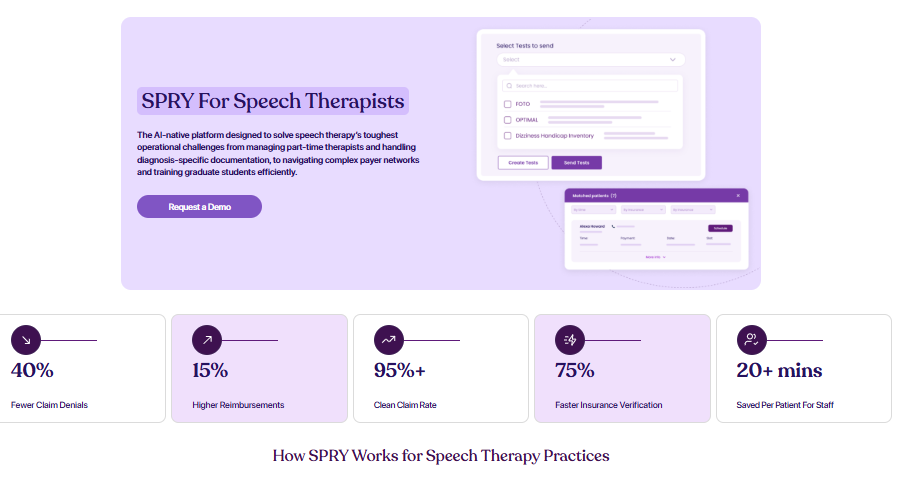
SPRY Scribe captures the session and drafts structured notes that include articulation accuracy data, cue levels, language targets and swallowing observations. It supports school, medical, pediatric and private practice settings, dysphagia documentation with IDDSI terms, AAC evaluation write-ups and IEP-aligned progress notes, and it connects to SPRY's eligibility checks, billing and SOAP documentation. The SLP reviews and signs every note. Details: AI scribe for speech-language pathology.
AI practice and therapy apps for patients
2. Jessica by Better Speech
Jessica is an AI speech therapy assistant that uses speech recognition and large language models to assess practice attempts and give feedback between sessions with a speech therapist. It is available around the clock on any device and covers children and adults, including stuttering, accent modification, apraxia and language goals. Better Speech positions it as a supplement to, not a replacement for, a licensed SLP. Source: Better Speech.
3. Constant Therapy
Constant Therapy is a digital speech, language and cognitive therapy app for people recovering from stroke or TBI and those with aphasia, dementia or Parkinson's disease. Its NeuroPerformance Engine compares each user's progress with others who have similar goals and adapts the program automatically. A clinician app lets SLPs assign home programs. Source: Constant Therapy.
4. Otsimo Speech Therapy

Otsimo's speech therapy app uses voice and speech recognition with machine learning to hear what the child says and adjust its games. It is designed for ages 1 to 8, with use up to age 15 depending on needs, and offers a free trial before monthly, annual or lifetime plans. Source: Otsimo FAQ.
5. Speech Blubs
Speech Blubs is a kids' speech app with over 1,500 activities built on video modeling: children watch other children say words and copy them, using face filters to stay engaged. It targets ages 1 to 8, including children with speech delay, Down syndrome, articulation issues and autism, and is sold by subscription after a free trial. Source: Speech Blubs.
General AI assistants for SLP materials
6. Large language model assistants
General AI chat tools can draft therapy materials, word lists, social stories, parent handouts and first drafts of goal wording. Treat the output as a draft: check clinical accuracy, age-appropriateness and cultural fit. Never paste identifiable patient information into a tool unless your organization has a Business Associate Agreement (BAA) with the vendor that covers that use.
Speech technology that is not AI: SpeechVive
SpeechVive is often listed with AI tools, but it is a wearable device rather than an AI system. For people with Parkinson's disease, it plays background noise while the wearer talks, which "elicits an automatic reflex called the Lombard Effect" so they speak louder and clearer in everyday conversation. Source: University at Buffalo.
SLP documentation time savings calculator
SLP documentation time savings calculator
Estimate what an AI scribe could give back. Use your own numbers: time a note takes you now and the time to review an AI draft.
An estimate from your inputs only. Actual savings depend on the tool, your setting and how much editing each draft needs. This tool does not store any data.
HIPAA, ASHA and Medicare rules for AI in speech therapy
| Area | What to check |
|---|---|
| HIPAA | Any tool that handles PHI needs a signed BAA, encryption, access controls and audit logs. HIPAA applies to SLPs who are covered entities, which includes most who bill insurance electronically |
| ASHA Code of Ethics | Principle II asks clinicians to evaluate any technology they use; AI supports clinical judgment and does not replace it |
| Evidence | ASHA: efficacy claims for AI tools must be substantiated with evidence. Ask vendors for published data |
| Section 1557 nondiscrimination | Since May 2025, covered providers must identify patient care decision support tools that use protected characteristics and take reasonable steps to mitigate discrimination risk |
| Medicare | Notes must support medical necessity for SLP CPT codes such as 92507 and 92523; the 2026 KX threshold is $2,480 for PT and SLP combined |
| Clinician review | Read and edit every AI-drafted note before signing; you are responsible for its content |
Sources: ASHA, generative AI for clinicians, HHS covered entities, Health Affairs on the Section 1557 rule. See also HIPAA and AI security requirements, HIPAA-compliant speech-to-text for SLPs and the KX modifier guide.
How to choose a speech therapy AI tool
- Start with the problem: documentation time, home practice, adult neuro rehab or materials. Each needs a different tool.
- Ask for evidence: published studies, validation in your population, and what happens when the AI is wrong.
- Check privacy: signed BAA, where recordings are stored, and whether data trains the vendor's model.
- Pilot it: try it with a few caseloads for a month and compare note time, edits needed and patient engagement.
- Keep the clinician in charge: AI drafts, scores and suggests; the SLP decides.
More SLP resources: SPRY for speech therapy, speech therapy CPT codes, AAC Profile assessment and articulation progress tracking.
FAQs
What is the best AI for speech therapy?
It depends on the job. For documentation, an AI scribe such as SPRY Scribe; for home practice, Jessica by Better Speech or Otsimo for children; for adult aphasia and cognitive rehab, Constant Therapy.
What is the primary function of speech AI?
To recognize and analyze spoken language, turning speech into text or data so a tool can score practice, draft documentation or adapt exercises.
Can AI replace a speech-language pathologist?
No. ASHA states AI cannot replace the SLP or assistant. AI tools support practice and paperwork; assessment, diagnosis and treatment decisions stay with the clinician.
Is there an AI speech therapy app for kids?
Yes. Otsimo Speech Therapy uses speech recognition for ages 1 to 8, and Speech Blubs uses video modeling for children with speech and language delays. Use them alongside, not instead of, an SLP.
Are speech therapy AI tools HIPAA compliant?
Only if the vendor protects PHI and signs a Business Associate Agreement. Avoid entering patient details into consumer AI tools without a BAA.
What AI tools do SLPs use for documentation?
AI scribes that listen to or summarize the session and draft SOAP, daily and progress notes, such as SPRY Scribe. The SLP reviews and signs each note.
Is SpeechVive an AI device?
No. SpeechVive is a wearable for Parkinson's disease that plays noise while the user speaks, triggering the Lombard effect so they speak louder.
Reduce costs and improve your reimbursement rate with a modern, all-in-one clinic management software.
Get a DemoLegal Disclosure:- Comparative information presented reflects our records as of Nov 2025. Product features, pricing, and availability for both our products and competitors' offerings may change over time. Statements about competitors are based on publicly available information, market research, and customer feedback; supporting documentation and sources are available upon request. Performance metrics and customer outcomes represent reported experiences that may vary based on facility configuration, existing workflows, staff adoption, and payer mix. We recommend conducting your own due diligence and verifying current features, pricing, and capabilities directly with each vendor when making software evaluation decisions. This content is for informational purposes only and does not constitute legal, financial, or business advice.

