
A note from our founder
Why we’re moving to spryhealth.ai
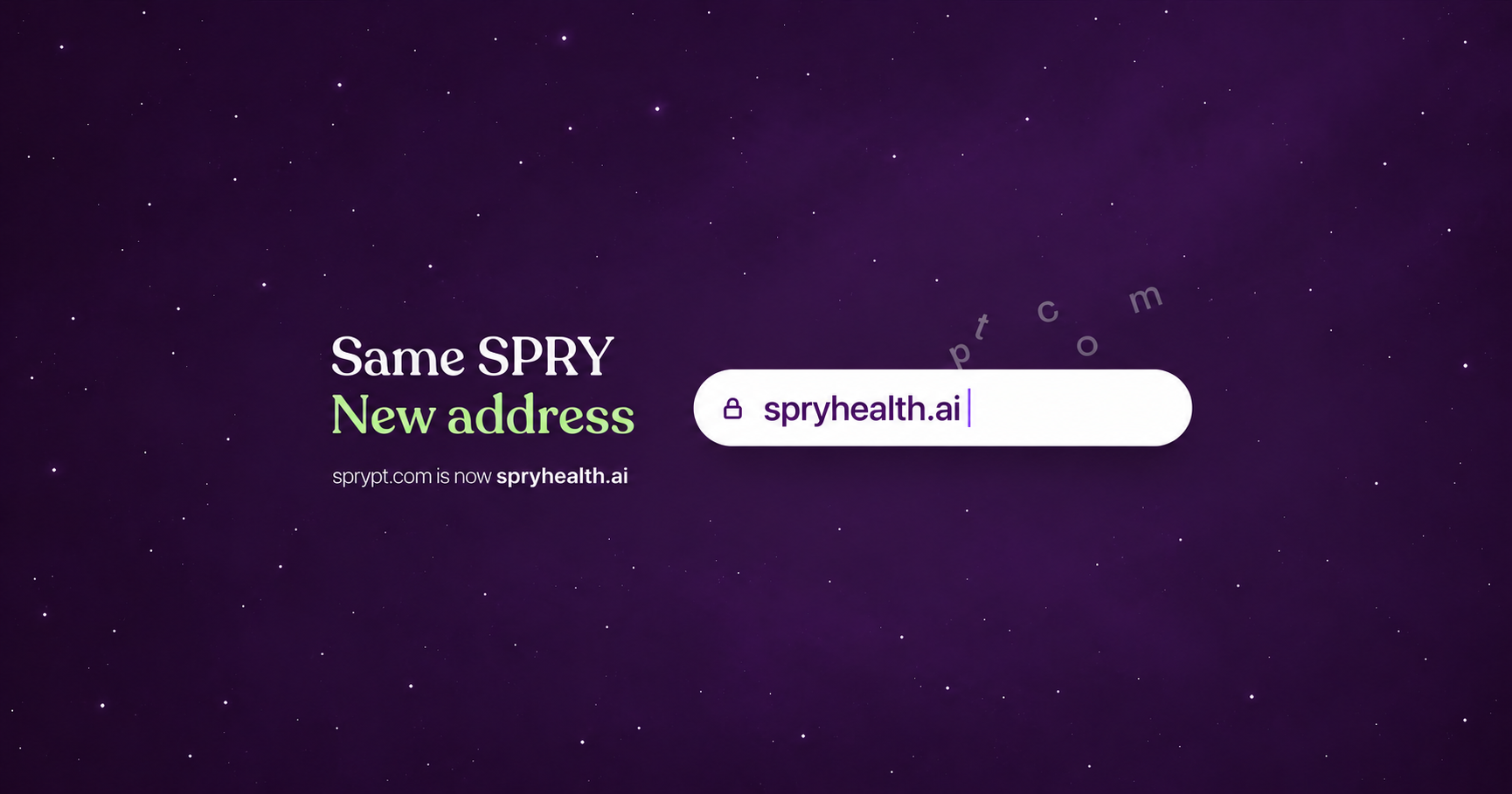
Our website is moving from sprypt.com to spryhealth.ai. The team and product stay the same. Your email contacts, clinic logins, and help center are unchanged.
- Same team
- Same product
- Same logins
.gif)

Email contacts
Unchanged.
Clinic logins
Unchanged.
Help center
Unchanged.
SPRY started in physical therapy. Today, we also serve occupational, speech, pediatric therapy practices and chiropractic care. Our address should reflect the clinics using the product and the role AI is taking in their work.
For years, my conversations with clinic owners focused on why they needed better software. More of those conversations now start with AI. The harder question is what it should do.
We started by helping clinicians finish notes faster and reducing clicks. That mattered to therapists who stayed late to finish their charts. But even with a faster note, someone still had to check what came next, find missing information, and move the work forward.
What I care about is reducing how much work needs to exist.
Every missing detail someone has to chase, every status someone has to check, and every handoff someone has to coordinate adds work to running a clinic.
Software should be able to take the next step when the information is complete and the requirements are clear. When a decision needs judgment, it should bring in a person with enough context to make that decision.
What an agent’s failure taught us
When we first deployed agents, one couldn’t submit claims because patient records were incomplete. A person would have called the clinic, filled in the gaps, and kept going. The agent stopped.
So we asked why the records were incomplete. The gap was in our own product, and a person had always covered for it.
We added a view to the task dashboard so clinics could identify records that needed attention before they blocked a claim. That moved the work earlier, where clinics could address it before a submission failed.
It also changed how we looked at the workflow. Getting the agent to submit a claim required us to examine the information and steps it depended on, including gaps people had learned to work around.
Building with agents has taught us more about our own product than about the agents.
What we’re building toward
Today, SPRY’s agents can read a fax, check coverage, hold a claim with the reason it needs attention, and follow up on a claim stuck at a payer.
The next step I want us to build is a more connected experience. Someone should be able to ask about a patient or a claim in plain language, get an answer from the relevant record, and have the software take the appropriate next step.
That is the direction we’re working toward. It shouldn’t be read as a claim that the entire experience is available today.
When a person intervenes, we should learn from what happened. Some decisions will continue to need their judgment. When the same issue keeps recurring, we should improve the workflow so people don’t have to keep solving it case by case.
Clinicians, front desks, and billers have long carried the work of interpreting eligibility rules, checking payer requirements, and resolving incomplete information. Building AI into those workflows makes us responsible for examining how much of that work the software can take on, and where people need to remain involved.
Why the address is changing
spryhealth.ai reflects both the practices we serve beyond physical therapy and our approach to building software that takes on more administrative work.
The domain change doesn’t require you to move your clinic to a new system or change how you access SPRY. We’ll continue improving the product you already use, guided by what we learn from the work happening inside your clinic.

Questions about the change?
If you have a question about the change, write to me directly.
Send Brij your question